SketchUp Workflow

Render Any SketchUp Model with AI, in the Browser

The model opens in a 3D view with camera, lighting and time-of-day controls. Give it a reference image for the materials, render every angle you need, then animate the best one into a walkthrough.

Trusted by 20,000+ architects and designers

What Changes

Can You Render in SketchUp?

Not photorealistically on its own. Fenestra is AI rendering software for SketchUp: export the model as GLB or FBX, drop it into the browser, and it renders in seconds with materials from a reference image. Four things change.

Works from the export you already have

File > Export > 3D Model is the whole setup. No licence to renew and no render settings panel to learn.

Materials from a reference image

Drop in a photo of the look you want and the model takes its materials, light and mood from it. No material library to build first.

Your camera, kept

The imported model sits in a 3D view with FOV, time of day and environment controls. Frame the shot you set up in SketchUp and render that.

Video from the same file

Once the still is right, send it through the video step for an orbit, push-in or flythrough as an MP4.

How Do You Render a SketchUp Model Online?

In the browser, in one session. Watch the forest pavilion go from GLB import to finished render: framed in the 3D view, materials from a reference photo.
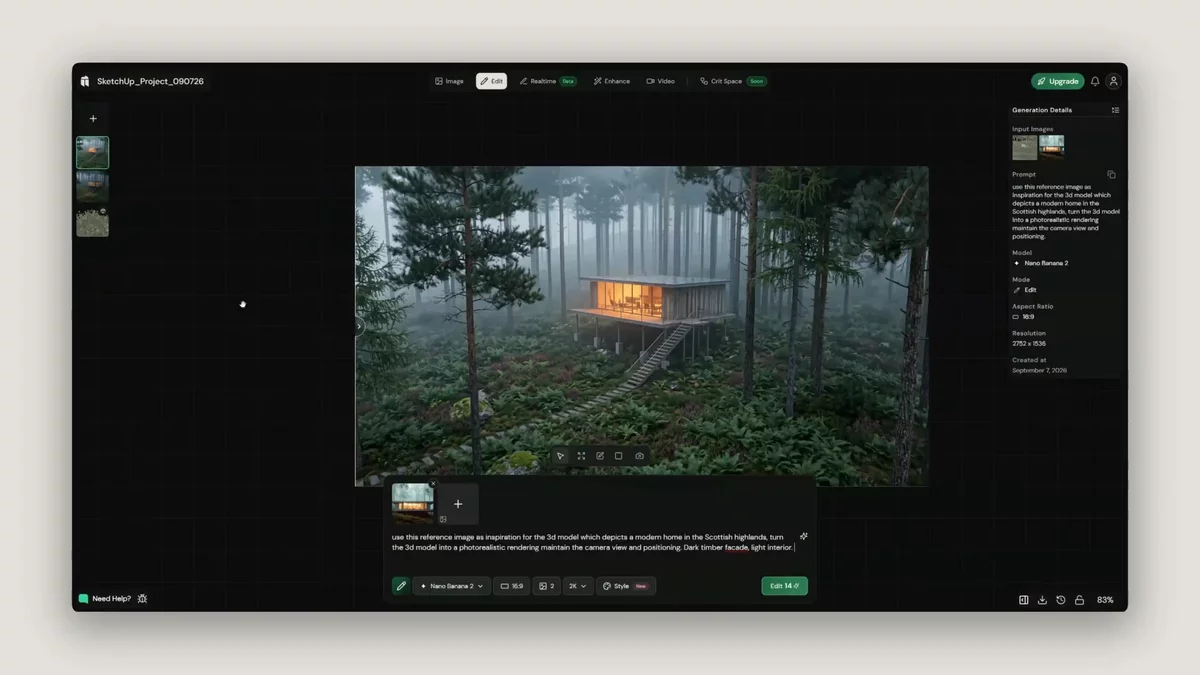
Screen recording of the Fenestra editor turning an imported SketchUp forest cabin model into a photorealistic render using a reference image

Workflow

How Do You Render a SketchUp Model with AI?

Four steps from the SketchUp viewport to a finished render. Nothing to install.

Step 1

Export from SketchUp

File > Export > 3D Model. Save as glTF Binary (.glb) or FBX.

Step 2

Drop it into Fenestra

Drag the file onto the canvas. The model opens in a 3D view in the browser.

Step 3

Frame the shot

Set the camera, FOV and time of day. Add a reference image and describe the materials.

Step 4

Render and download

A photorealistic still in seconds. Change the angle, the light or the season and render again.

Specifications

Which Rendering Software Is Best for SketchUp?

The one that takes the export you already have and gives you the same controls for every model.

SketchUp's export dialog with the Save as type list open and glTF Binary (.glb) selected

GLB, FBX or 3DM

Straight from SketchUp's own export list

Seconds

Per render, in the browser

No GPU

Runs on the laptop you model on

Aerial render of the same glazed cabin on stilts in a misty pine forest, with a stepping-stone path leading to its stair

Any angle

Orbit the imported model and render every view from one file

Reference image

Materials, light and mood taken from a photo you supply

Time of day

Sunrise to sunset on a slider

MP4

Animate the finished render into a walkthrough

Commercial rights

Included on every paid plan

What Does Render Mean in SketchUp?

The viewport is the model. The render is the same model with real materials, light and atmosphere. Same camera. Drag the handle.

The SketchUp viewport: a flat-shaded cabin on stilts among low-poly pine trees on a green slope
The same cabin rendered photorealistically, with mist between the pines, heather on the slope and warm light inside

How Do You Make a SketchUp Render Realistic?

Give it the model and a reference image. The model sets the geometry and the camera. The reference sets the materials, the light and the weather.

Your SketchUp model
Reference image

How Do You Add Materials to a SketchUp Render?

From the reference image. Dark timber facade, light interior, mist in the trees, and the geometry is the SketchUp model, untouched.

After Import

How Do You Add Lighting to a SketchUp Render?

Time of day and light intensity are sliders on the imported model, and so is everything else here. One export covers the whole presentation.

Time of day

Light intensity

Camera angle

Season and weather

Reference image

Walkthrough video

Who Uses Fenestra to Render Their Models?

More than 200,000 renders have been generated in Fenestra. Here is how practices use it alongside their modelling tools.

“Great tool for initial concepts. We provide new house and land packages and use Fenestra to update external colour scheme facade renders and floor plans for marketing purposes. Fenestra is a quick way to provide the images to clients to visualise their new home.

Michelle Morrison
Designer · Urbane Homes
Urbane Homes
“Fenestra is a great tool and works really well for us. We’re using it to help establish a new internal standard for visualisation across the office, making it easier for high-quality visuals to become part of our standard project package.

Bjørn Polzin
Head of Planning · apoprojekt
apoprojekt
“What sets Fenestra apart is the people behind it. The team is always available, genuinely listens to user needs, and provides a level of support that is responsive, approachable, and highly professional.

Raquel González
Real Estate Marketing Department · VAPF
VAPF

Plans & Pricing

Individual

Perfect for students & solo designers

$16
$8/ mo
Billed yearly ($96/year)saving 20%
200 Credits / month· 4¢ each
  1. ~200 Renders /Month
  2. ~20 Videos /Month
  3. AI Enhanced Prompting
  4. Commercial Use
Popular

Pro

Perfect for Professionals

$56
$28/ mo
Billed yearly ($336/year)saving 20%
1000 Credits / month· 2.8¢ each

30% cheaper per credit than Individual

Private by default · We don't train on your data
  1. ~1000 Renders /Month
  2. ~100 Videos /Month
  3. ~500 Enhanced Renders /Month
  4. 5x Credits
  5. Commercial Use
  6. Image Editing
  7. Fast Support
  8. Fast Rendering
  9. Unlimited Projects
  10. Share 3D
  11. Team Tools (Coming Soon)

Studio

For professionals and studios creating at scale

$96
$48/ mo
Billed yearly ($576/year)saving 20%
2k4k6k8k
2000 Credits / month· 2.4¢ each

40% cheaper per credit than Individual

Private by default · We don't train on your data
  1. ~2000 Renders /Month
  2. ~200 Videos /Month
  3. ~1000 Enhanced Renders /Month
  4. Commercial Use
  5. Professional Image Editing
  6. Priority Render Speeds
  7. Priority Support
  8. Priority Feature Access
  9. Unlimited Projects
  10. Share 3D
  11. Team Tools (Coming Soon)

For Teams & Enterprises

One shared credit pool, shared projects, and centralised billing

Team

Perfect for small teams

$416.67
$208.33/ mo
Billed yearly ($2500/year)saving 20%
5k10k
5000 Credits / month· 4.2¢ each
Private by default · We don't train on your data
  1. up to 5 Seats
  2. 5000 Credits
  3. Shared Credit Pool

Enterprise

Custom solutions with dedicated support and admin features for scale

Let's Chat
  1. Flexible multi-user licensing
  2. Shared Credit Pools
  3. Centralized team admin & billing
  4. Personalized onboarding & support
  5. Shared AI model access

What Else Do People Ask About Rendering in SketchUp?

The questions that come up before rendering a SketchUp model with AI for the first time.

Fenestra renders a SketchUp model with AI from a GLB or FBX export. Export with File > Export > 3D Model, drag the file into Fenestra in the browser, frame the shot in the 3D view, add a reference image or describe the materials, and render. The first still comes back in seconds and the same file can be re-rendered from any angle.
glTF Binary (.glb) is the simplest: one file, geometry and grouping intact, and it is on SketchUp's standard export list. FBX also works. If you already have a Rhino .3dm of the same scheme, that imports too.
In Fenestra, give the SketchUp model a reference image. A photograph with the light, the materials and the weather you want does more than a paragraph of description, and the model takes its finish from it while the geometry stays yours. Then set the time of day and the environment strength and render again.
Fenestra animates a SketchUp render into a walkthrough video. Render the still first, then send it through the video step and choose a camera move: orbit, push-in, pan or flythrough. The result is an MP4 for a client presentation, a competition board or a reel, with no camera path to keyframe in SketchUp.
Yes. A JPG or PNG of the viewport renders in the same way as a sketch or a CAD elevation. Exporting the 3D model is better when you want to move the camera afterwards, since a screenshot fixes the angle.
Yes. Everything generated on a paid plan comes with full commercial rights, which covers client presentations, planning submissions, competition entries, your website and social channels.
Fenestra renders SketchUp models without a plugin. Export with File > Export > 3D Model and render in the browser. Nothing is installed inside SketchUp, so there is no V-Ray, Enscape, D5 or Twinmotion licence to hold and no render settings to learn.
Yes. The imported model sits in a 3D view, so the render is generated from the geometry you drew and the view you frame. The proportions, openings and site relationships stay where you put them. Materials and lighting are what change.
Yes. Fenestra renders SketchUp models online, on its own servers, so the laptop you model on is enough. There is no render farm to queue for and no workstation to buy.
Yes. Nano Banana 2 is one of the models you can pick in Fenestra, and it handles an imported SketchUp model well: the geometry stays put while the materials and light come from your reference image or description. Choose it from the model list on the prompt bar, or switch to another model for the same shot.
V-Ray, Enscape and D5 render inside SketchUp from materials and lights you set up by hand, with the licence and GPU that implies. Fenestra renders the exported model from a description or a reference image in seconds, which suits concept work, options and client meetings where the setup time is not worth it.
Plans start at $10/month on the Individual tier and $35/month on Pro, with Team plans for studios. Annual billing saves 20%. Renders and videos draw on a shared credit pool, with the exact cost shown in the app before you run it.